
5 Questions You Should Ask Before Investing in FEA Simulation
Finite Element Analysis can save weeks of prototyping and catch failures long before they reach the field. But it only delivers that value when it’s set up to answer the right question, with the right inputs, by the right people.
Whether you’re weighing an in-house simulation capability or bringing in an outside partner, these five questions separate simulation that pays for itself from simulation that produces impressive-looking plots and little else.
New to the method? Start with our primer: What Is Finite Element Analysis and Why Is It Important?
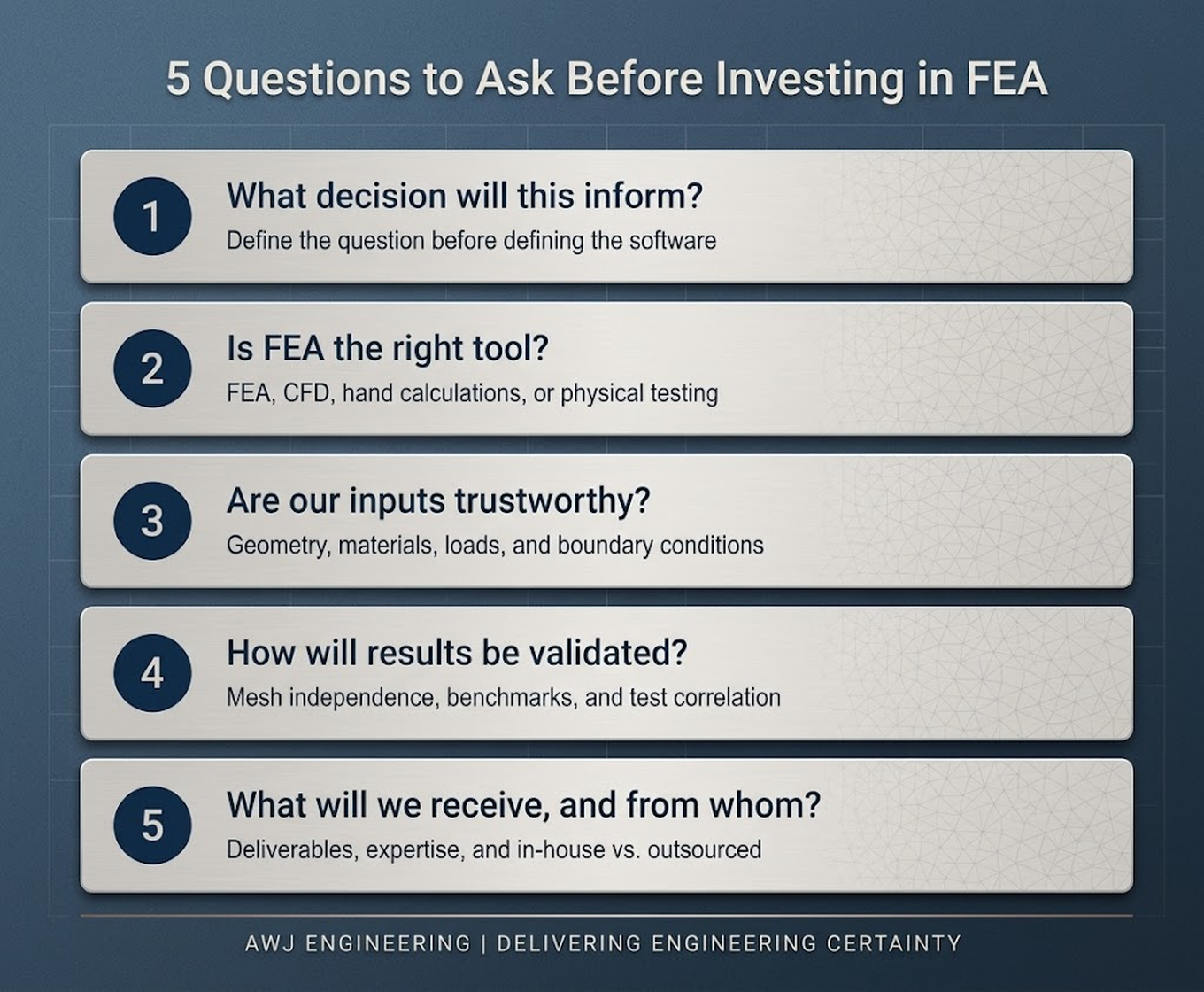
- What Decision Is This Analysis Supposed to Inform?
Every good simulation starts with a question.
- “Will this bracket survive a shock load during shipping?” is a clear question.
- “How much material can we remove before the safety factor drops below 2?” is a clear question.
- “Why did this part crack in the field?” is a clear question.
- “Let’s run FEA on it” is not.
The question matters because it determines the scope, fidelity, and cost of the work. A quick linear static check to compare two design concepts is a fraction of the effort of a nonlinear, fatigue-driven study to support certification. Without a defined decision, it’s easy to overspend on precision you don’t need, or underspend on a model that can’t answer what you actually care about.
Ask yourself: What will we do differently depending on the result? If the answer is “nothing,” the analysis may not be worth running yet.
- Is FEA the Right Tool for the Physics Involved?
FEA is exceptional for structural loads, heat conduction, vibration, and coupled Multiphysics problems. But not every problem is an FEA problem:
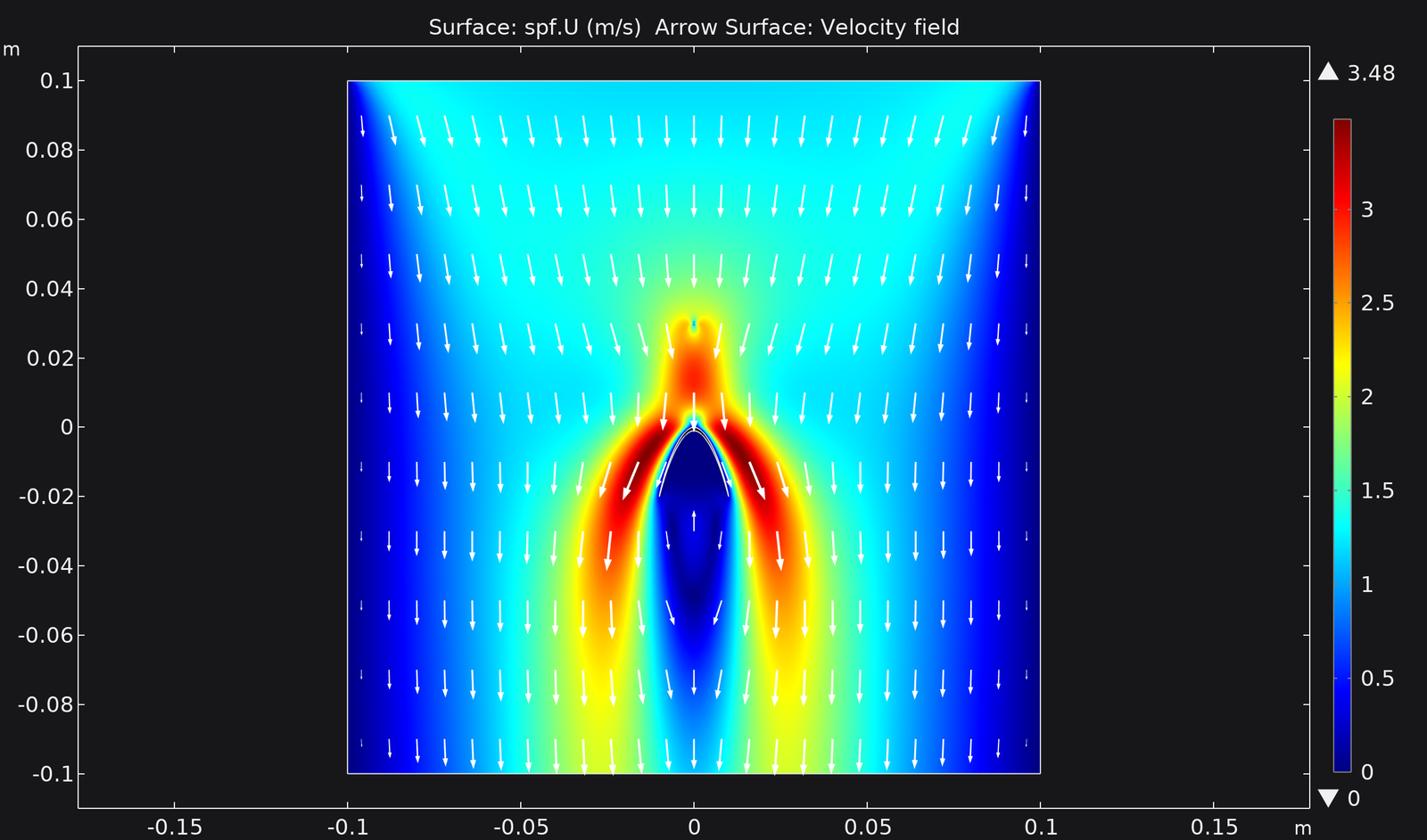
- Fluid flow through a valve or over a surface is a CFD problem.
- A simple beam in bending may only need a hand calculation.
- Some questions can only be settled by physical testing.
Many real-world problems also cross boundaries. Thermal stress from a hot fluid, or a flexible structure deforming under airflow, means a single-physics model can miss the point entirely.
Ask yourself: Which physics dominate this problem, and do they interact? A good simulation partner will tell you when you need FEA, when you need CFD, when you need both, and when you need neither.
- Do We Have the Inputs to Make the Model Trustworthy?
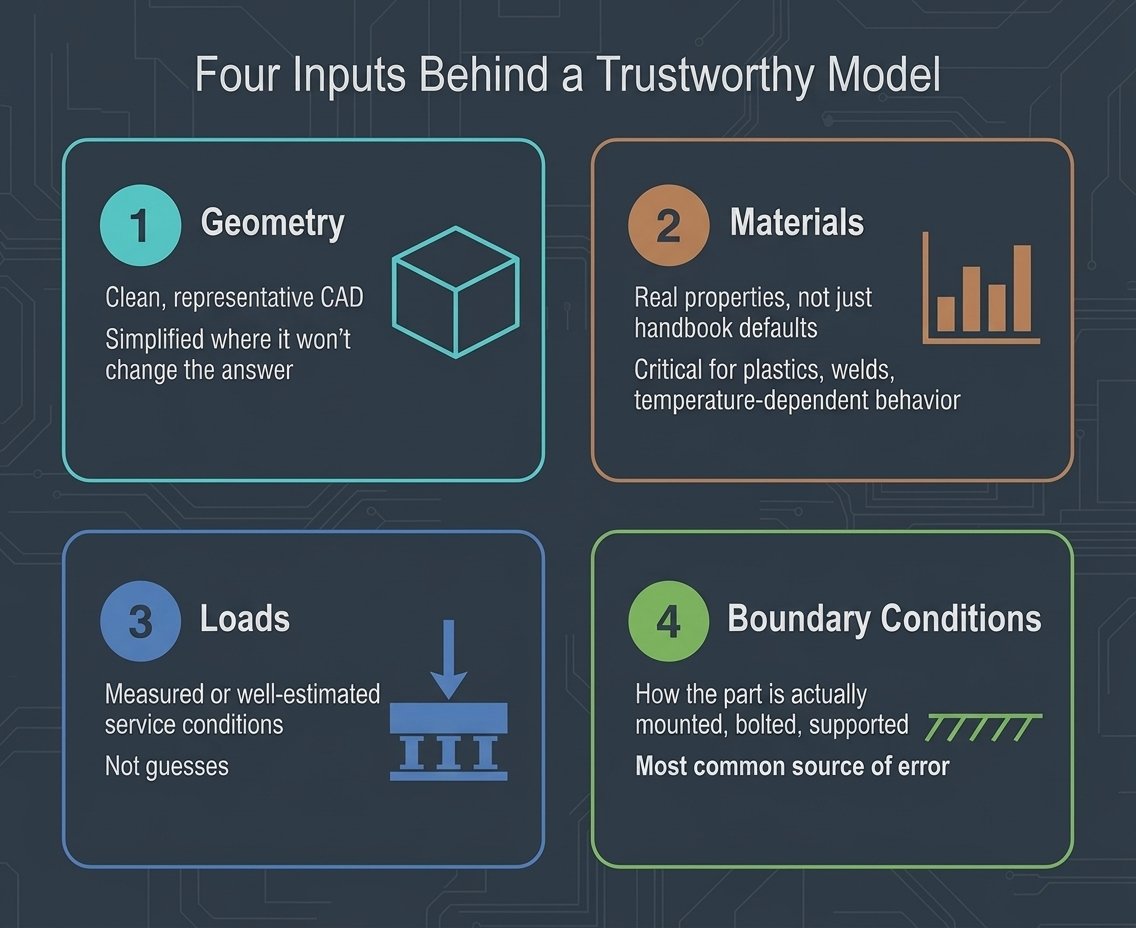
A simulation is only as good as what goes into it. Four inputs matter most:
- Geometry: Clean, representative CAD, simplified where it makes sense (small fillets or cosmetic features can bloat a model without changing the answer).
- Materials: Real properties, not just generic handbook values. This matters especially for plastics, composites, welds, and any material whose behavior changes with temperature.
- Loads: Measured or well-estimated service conditions, not guesses.
- Boundary conditions: How the part is actually mounted, bolted, or supported. This is the most common source of misleading results, and it’s the input engineers most often assume rather than verify.
You don’t need every input perfect on day one. But you do need to know which ones are solid and which are assumptions, so the uncertain ones can be tested with sensitivity checks or measured directly.
Ask yourself: What do we know, and what are we assuming? Where the assumptions are shaky, can we test or measure them first?
- How Will the Results Be Validated?
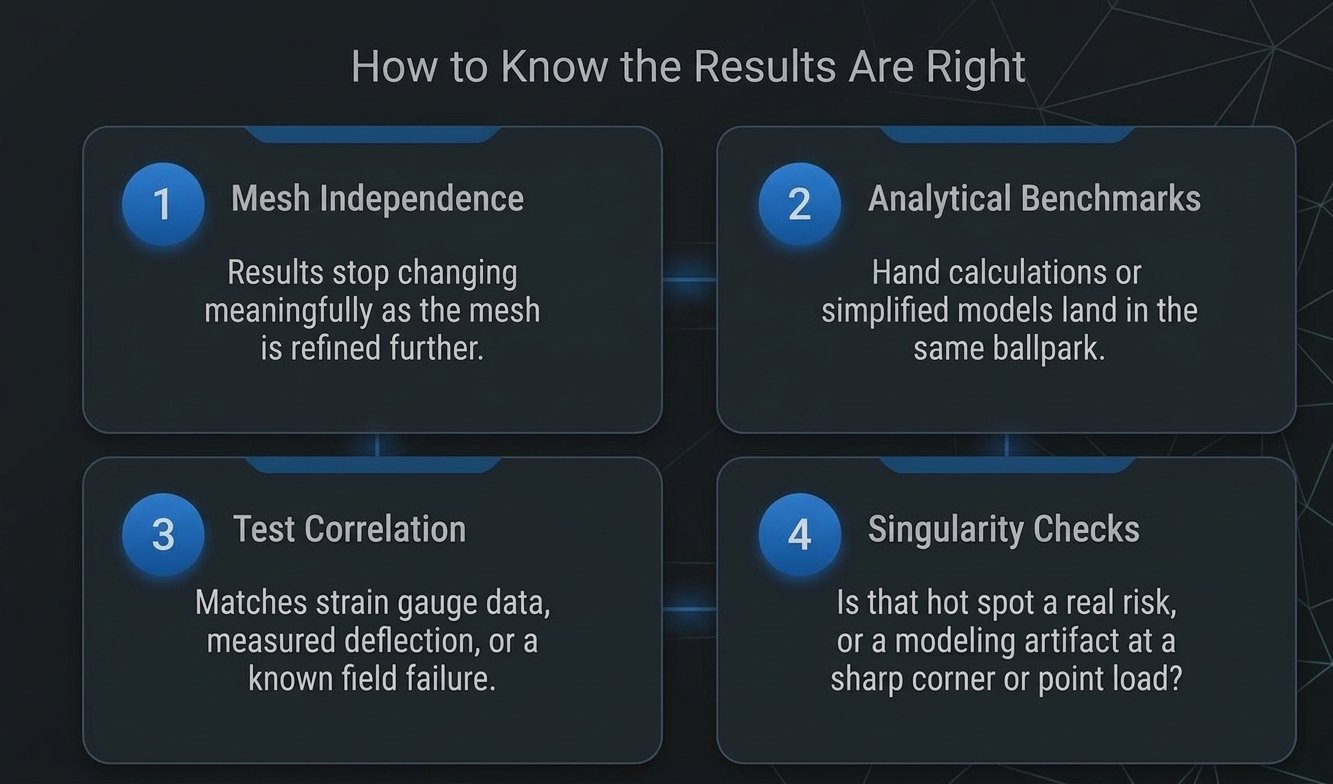
A colorful stress plot is not proof. Before investing, ask how confidence in the results will be established:
- Mesh independence study: Do the results stop changing meaningfully as the mesh is refined? If they don’t, the answer is a product of the mesh, not the physics.
- Analytical benchmarks: Do hand calculations or simplified models land in the same ballpark?
- Test correlation: Do results match strain gauge data, measured deflection, or a known field failure?
- Singularity checks: Is that red hot spot a real failure risk, or a modeling artifact at a sharp corner or point load?
In regulated industries such as aerospace, medical devices, and pressure equipment, validation isn’t optional. It’s part of the qualification package.
Ask yourself: How will we know the model is right, and how accurate does it need to be for our decision?
- What Will We Actually Receive, and Who Is Behind It?
Two things determine whether an FEA investment turns into better designs: what you get back, and who produced it.
Deliverables. Screenshots alone aren’t a deliverable. Look for a report that documents the assumptions, loads, and boundary conditions; ties results to a clear recommendation (pass, fail, redesign here, remove material there); and states the limitations of the analysis.
Expertise. Simulation software is increasingly a commodity whereas judgment is not. Knowing which results to trust, which to question, and which modeling shortcuts quietly invalidate the outcome comes from experience with your type of problem.
In-house or outsourced? Building an in-house capability makes sense when you have steady simulation volume, budget for licenses and training, and analysts who will use the tools regularly. Working with an outside partner gives you immediate expertise, no license overhead, and flexible capacity for peak workloads. Many teams settle on a hybrid: routine checks in-house, complex or high-stakes analyses outsourced.
Ask yourself: What does the final deliverable look like? Who will run the analysis, and can we talk to them directly?
Quick Checklist Before You Commit
- We can state the decision this analysis will support
- We’ve confirmed FEA (alone or paired with CFD or testing) is the right method
- Geometry, materials, loads, and boundary conditions are defined, or the assumptions are documented
- We’ve agreed how the results will be validated
- We know what the deliverable looks like and who is responsible for it
If you can check all five, you’re ready to invest with confidence. If you can’t, the gaps are exactly where a conversation with a simulation specialist saves the most time and money.
Talk to AWJ Engineering Before You Start
At AWJ Engineering, our FEA services cover linear and nonlinear structural, fatigue, thermal, and coupled multiphysics analysis using tools like ANSYS and COMSOL. Not sure yet whether FEA is the right fit, or what your project needs? That’s a perfectly good place to start.
Have a design to validate? Contact AWJ Engineering and let’s scope it together.
