

What Is Finite Element Analysis and Why Is It Important?
If you design or manufacture physical products, at some point you’ve probably asked: will this part actually survive the loads it’s going to see? Finite Element Analysis (FEA) is how engineers answer that question before a single prototype is cut – and it’s one of the most valuable tools in modern product development.
At AWJ Engineering, FEA is part of how we deliver engineering certainty to clients across aerospace, automotive, biomedical, energy, and industrial machinery. Here’s what it is, how it works, and why it belongs in your design process.
What Is FEA?
Finite Element Analysis is a computational method for predicting how a part or assembly behaves under real-world conditions – structural loads, vibration, heat, pressure, and more – without physically building and testing it.
The core idea is simple, even if the math underneath is not: take a complex geometry that can’t be solved analytically as a whole, and break it into thousands (or millions) of small, simple pieces called finite elements. Each element is connected to its neighbors at shared points called nodes, forming a mesh. The physics governing each individual element – how it stretches, bends, or heats up – is easy to describe mathematically. Stitch the equations for every element together, and you get a system that approximates the behavior of the entire part.
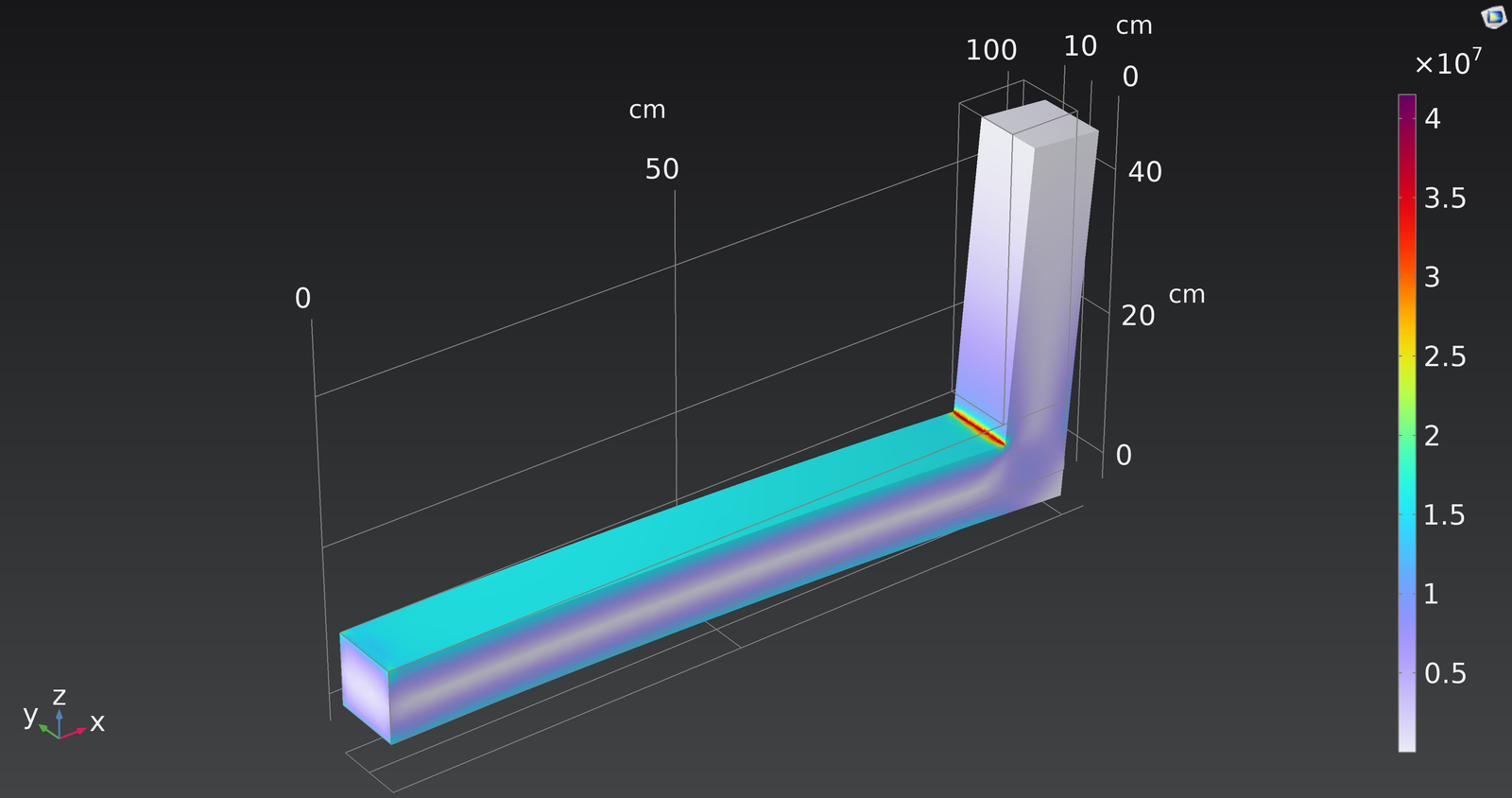
A simulation software solves that system of equations and returns a detailed, visual result: where stress concentrates, how much a part deflects, where it’s likely to fail first, and by how much margin it survives.
How the FEA Process Works
![What Is FEA and Why Is It Important? [Finite Element Analysis - Awj Engineering]](https://awjengineering.com/wp-content/uploads/2026/09/fea-workflow-phases.png)
A typical structural Finite Element Analysis study follows a consistent workflow, grouped into three phases – setting up the model, solving it, and interpreting the results:
- CAD Geometry: The process starts with a 3D model of the part – either provided by the client or built in-house.
- Meshing: The geometry is divided into finite elements. Mesh quality is critical here: too coarse a mesh misses local stress concentrations (like the corner of a bracket or the root of a fillet); too fine a mesh wastes computation time without meaningfully improving accuracy. Getting this balance right – often through a mesh independence study – is one of the most important skills in simulation work.
![What Is FEA and Why Is It Important? [Finite Element Analysis - Awj Engineering]](https://awjengineering.com/wp-content/uploads/2026/09/Mesh.png)
- Material Properties Real material behavior is assigned to the model: elastic modulus, yield strength, Poisson’s ratio, and, for more advanced studies, plasticity, fatigue, or temperature-dependent properties.
- Boundary Conditions and Loads This is where engineering judgment matters most. How is the part actually mounted? What loads does it see in service – static, cyclic, impact, thermal? Boundary conditions that don’t reflect reality will produce results that don’t either, no matter how refined the mesh is.
- Solving The software solves the resulting system of equations – sometimes millions of them – to calculate displacement, stress, strain, and other outputs across the entire model.
- Post-Processing and Interpretation Raw numbers become color-coded stress plots, deflection animations, and safety factor maps. This is where an experienced analyst adds real value: distinguishing a stress singularity (a modeling artifact) from a genuine failure risk, and translating results into a design recommendation.
Why Finite Element Analysis (FEA) Matters
It catches failures before they’re expensive
A redesign on a CAD model costs minutes. A redesign after a failed physical prototype costs weeks and real money. A redesign after a field failure can cost a product line – or a reputation. FEA moves failure discovery to the cheapest possible point in the development cycle.
It replaces guesswork with data
Traditional design relies on safety factors, rules of thumb, and experience. FEA lets you see exactly where stress concentrates and by how much, so safety margins are based on evidence rather than convention – which often reveals you can also reduce material and mass without giving up strength.
It supports lightweighting without guesswork
In industries like aerospace and automotive, every gram matters. FEA lets engineers push a design toward its real performance limits – removing material exactly where it isn’t needed – with confidence, rather than over-building out of caution.
It reduces physical prototyping
Physical testing is still essential for final validation, but FEA dramatically cuts down how many prototype iterations you need to get there, shrinking both cost and time-to-market.
It de-risks certification and compliance
In regulated industries – aerospace, medical devices, pressure equipment – simulation evidence is often a required part of the design qualification package, supporting or reducing the physical test matrix.
Where FEA Is Used
- Structural analysis – stress, deflection, and factor of safety under static or dynamic loads
- Fatigue analysis – predicting the service life of parts under repeated loading
- Thermal analysis – heat distribution, thermal stress, and thermal expansion effects
- Vibration and modal analysis – identifying natural frequencies to avoid resonance
- Drop and impact analysis – evaluating survivability under sudden shock loads
- Multiphysics simulation – coupling structural behavior with thermal, fluid, or electromagnetic effects for a complete picture of real-world performance
Getting FEA Right Is a Skill, Not Just a Tool
Running a simulation is easy. Running a correct one is not. The single biggest source of bad FEA results isn’t the software – it’s poorly defined boundary conditions, an under-resolved mesh, or a modeling simplification that quietly invalidates the results. Experienced analysts know where these tools can be trusted and where they need to be double-checked against theory, hand calculations, or physical test data.
That judgment is exactly what a specialized simulation partner brings to a project – not just running the software but knowing which results to trust.
Partner With AWJ Engineering for FEA
At AWJ Engineering, our FEA services span linear and nonlinear structural analysis, fatigue, thermal, and coupled multiphysics simulations using industry-leading tools like ANSYS and COMSOL. Whether you need a single design validation or ongoing simulation support across your product line, our team delivers results you can act on with confidence.
Ready to validate your next design? Explore our FEA services or contact AWJ Engineering to discuss your project.
