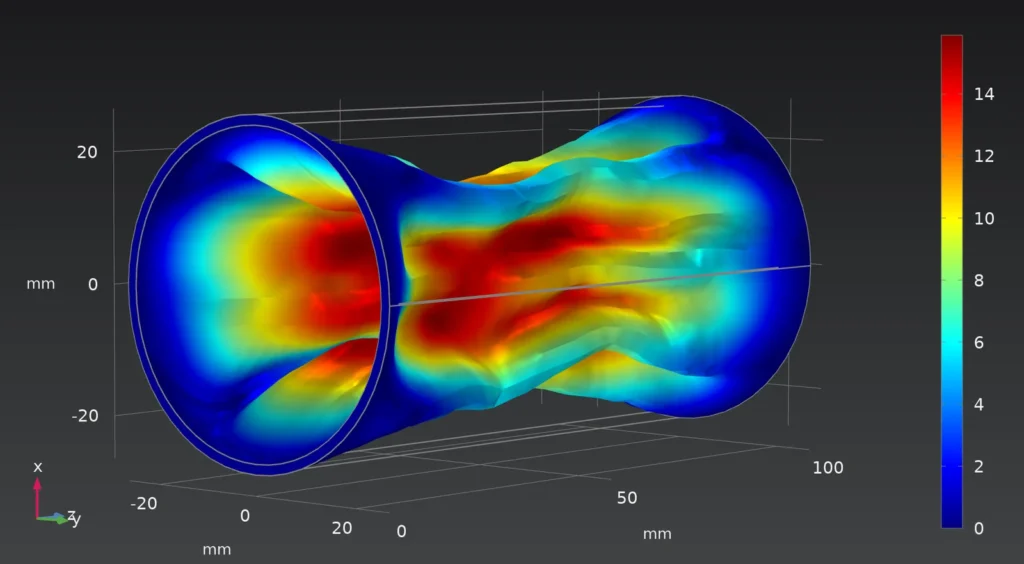

Transient Fluid-Structure Interaction (FSI) in Collapsible Elastic Tube
Industry:
Client Type:
Service Provided:
Objective:
Engineering Method:
Simulation Platform:
Core Focus:
Industry:
Biomedical Engineering / Fluid Mechanics Research.
Client Type:
Engineering team studying fluid-structure interaction systems.
Service Provided:
Multiphysics simulation and fluid-structure interaction analysis.
Objective:
Analyze how fluid flow interacts with the deformation of a thin-walled elastic tube.
Engineering Method:
Transient Fluid-Structure Interaction (FSI) using COMSOL Multiphysics.
Simulation Focus:
Coupled analysis of viscous fluid flow and elastic structural deformation.
Numerical Strategy:
Segregated finite element approach with moving mesh modeling.
At AWJ Engineering, our team employed a segregated finite element method to analyze steady viscous fluid flow through a thin-walled elastic tube mounted between rigid sections. We coupled Navier-Stokes equations with solid mechanics equations of motion and a constitutive material model, incorporating a deforming domain (moving mesh) to capture the tube’s deformation effects on fluid dynamics.
This project highlights our expertise in multiphysics simulations for precise, real-world insights.
For more details on boundary conditions, solver settings, or similar analyses, contact us today.
The Client
The client was conducting research into fluid-structure interaction phenomena within collapsible elastic tubes, a topic widely studied in biomedical engineering and fluid mechanics.
Understanding the interaction between fluid flow and flexible structures is essential in applications such as:
- blood flow through arteries and veins
- respiratory airflow in biological airways
- flexible piping systems in engineering
- soft-material fluid transport systems
In these systems, the structure containing the fluid is not rigid. Instead, it deforms in response to pressure and flow forces, which in turn alters the fluid dynamics.
The client required an advanced simulation study to examine how viscous fluid flow influences the deformation of a thin elastic tube and how that deformation feeds back into the fluid behavior.
The Challenge
Fluid flow in flexible structures introduces complex feedback interactions between mechanical deformation and fluid dynamics.
Key questions the client needed to address included:
- how the tube deforms under internal fluid pressure
- how structural deformation alters flow velocity and pressure distribution
- how steady viscous flow behaves in a flexible conduit
- how to accurately simulate these interactions using computational modeling
Traditional fluid simulations assume rigid boundaries, which makes them unsuitable for systems where the flow domain itself changes due to structural deformation.
To capture realistic system behavior, the simulation required a fully coupled fluid-structure interaction approach capable of modeling both physics domains simultaneously.
Engineering Challenge
Accurately modeling collapsible tube behavior requires solving multiple sets of equations that describe both the fluid and the structure.
The simulation needed to incorporate:
- Navier-Stokes equations governing viscous fluid flow
- solid mechanics equations describing structural deformation
- constitutive material models representing the elastic tube behavior
- a dynamic mesh that updates as the structure deforms
As the tube deforms, the fluid domain changes shape. This introduces additional computational complexity because the mesh must adapt dynamically while maintaining numerical stability.
Achieving accurate results therefore required a carefully structured Multiphysics simulation framework capable of handling moving boundaries and coupled physics interactions.
Our Approach
AWJ Engineering implemented a structured simulation workflow to analyze the interaction between fluid flow and structural deformation.
System Geometry and Structural Configuration
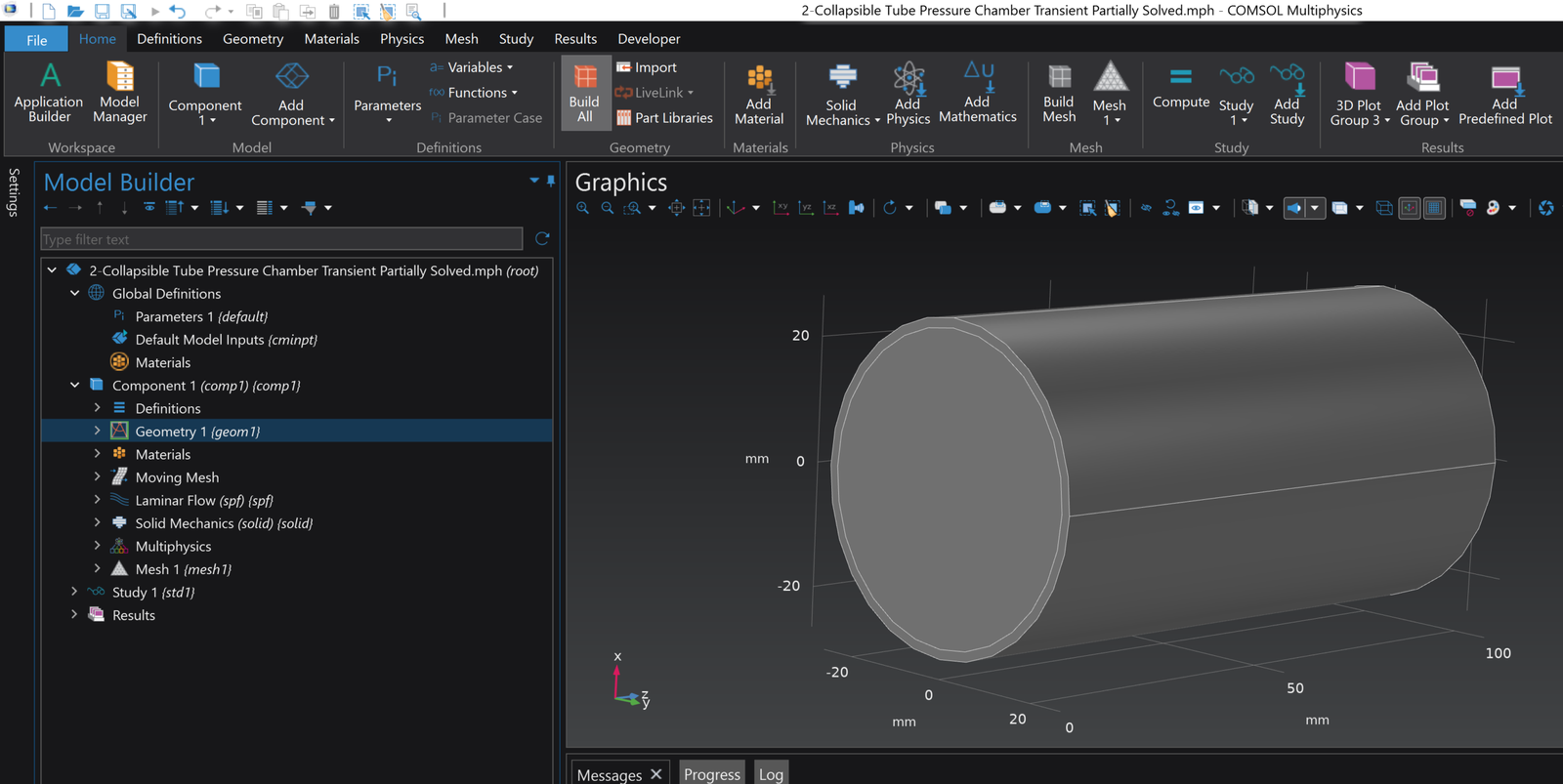
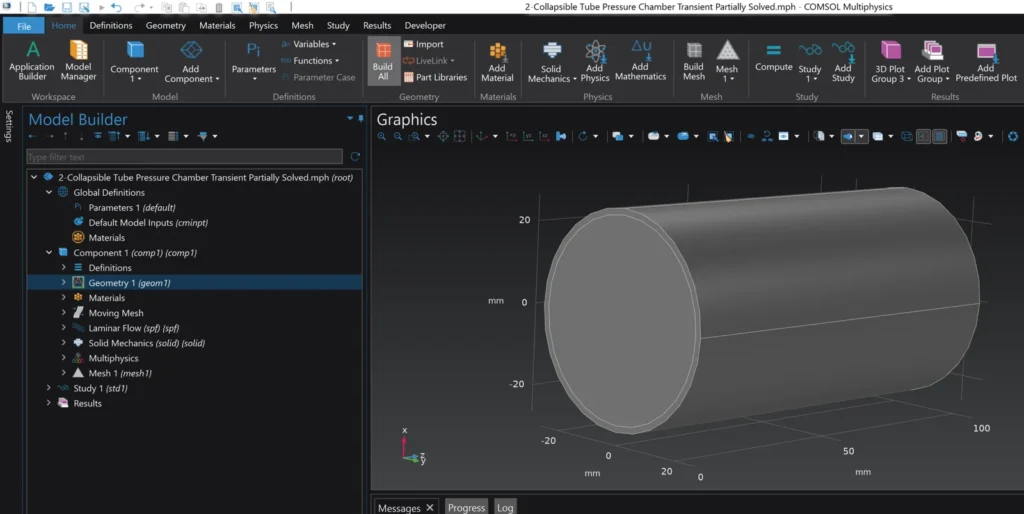
The Simulation model consisted of a thin-walled elastic tube positioned between two rigid sections.
This configuration allowed the study to isolate deformation effects within the flexible region while maintaining stable boundary conditions at the rigid interfaces.
Multiphysics Modeling Framework
The system was modeled as a coupled fluid-structure interaction problem, allowing the simulation to capture the dynamic interaction between fluid pressure forces and structural deformation.
Two primary physics domains were integrated:
- viscous fluid flow governed by the Navier-Stokes equations
- elastic structural response governed by solid mechanics equations of motion
Constitutive Material Modeling
The elastic tube was assigned a constitutive material model representing its mechanical properties, ensuring that the simulation accurately captured how the structure responds to internal pressure forces.
Moving Mesh Implementation
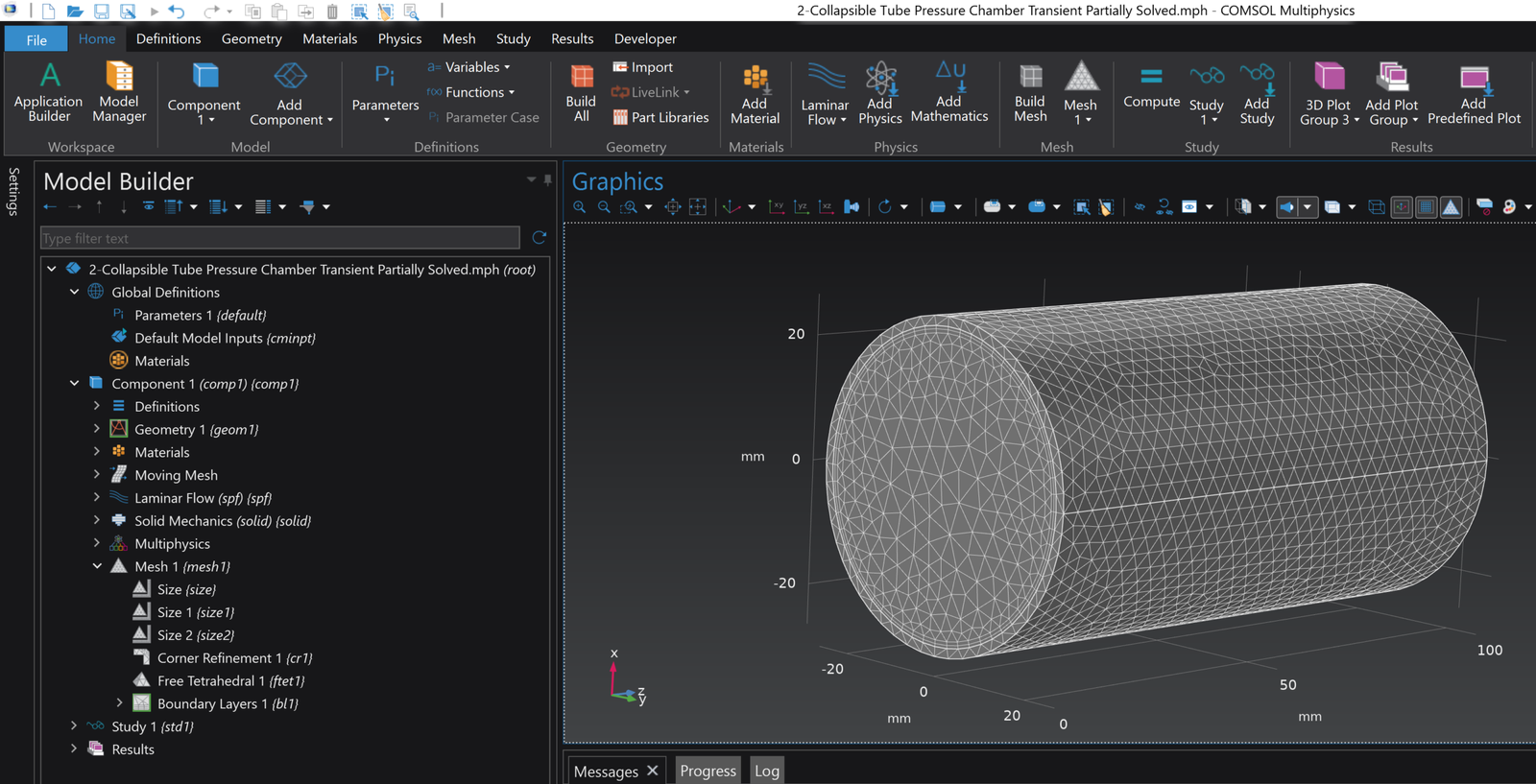
To represent the changing geometry of the fluid domain, the simulation incorporated a deforming mesh approach.
As the elastic tube deformed under fluid pressure, the computational mesh dynamically updated to reflect the new geometry. This allowed the simulation to accurately track the feedback interaction between structural motion and fluid flow.
Segregated Finite Element Solution Strategy
To maintain numerical stability while solving the coupled equations, a segregated finite element method was implemented.
This approach solved the fluid and structural physics iteratively, ensuring stable convergence while preserving the coupling between the two systems.
The Solution
Using advanced Multiphysics modeling techniques, AWJ Engineering successfully simulated the transient behavior of fluid flow through the collapsible elastic tube.
The simulation provided detailed insights into:
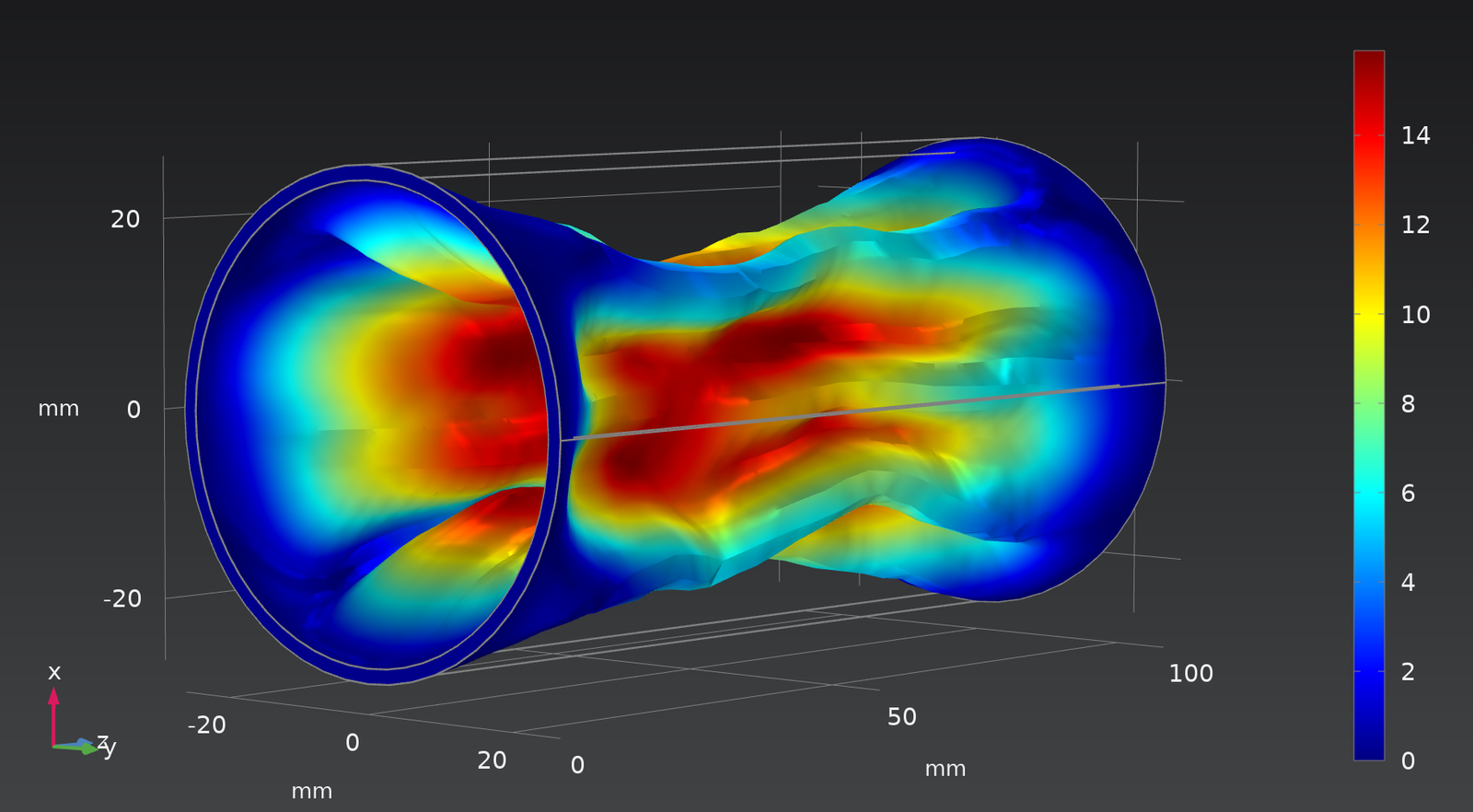
- deformation patterns along the flexible tube section
- changes in fluid velocity caused by structural movement
- pressure distribution within the deforming flow domain
- the dynamic interaction between viscous forces and structural elasticity
By capturing both the structural response and the resulting changes in fluid flow, the model produced a realistic representation of fluid-structure interaction within flexible conduits.
Technologies Used
Multiphysics Modeling: Electrostatic, Fluid Dynamics and PDE Module coupling
Numerical Methods: Finite Element Analysis (FEA), Computational Fluid Dynamics (CFD)
Simulation Focus: Electrohydrodynamic airflow modeling, Ion transport dynamics, Momentum exchange between ions and gas molecules
Validation Method: Benchmark comparison with established electrohydrodynamic research
Technologies Used
Simulation Methodology
Fluid-Structure Interaction (FSI)
Numerical Approach
Segregated finite element method
Fluid Modeling
Navier-Stokes equations for viscous flow
Structural Modeling
Solid mechanics equations of motion with elastic material model
Mesh Strategy
Deforming mesh for dynamic geometry updates
Multiphysics Modeling
Electrostatic, Fluid Dynamics and PDE module coupling
Numerical Methods
Finite Element Analysis (FEA) and Computational Fluid Dynamics (CFD)
Simulation Focus
Electrohydrodynamic airflow modeling, ion transport dynamics and momentum exchange
Validation Method
Benchmark comparison with established electrohydrodynamic research
Results & Business Impact
The project delivered a reliable simulation framework capable of analyzing complex fluid-structure interaction systems.
Key outcomes included:
- accurate prediction of elastic tube deformation under fluid pressure
- detailed visualization of velocity and pressure changes within the flow domain
- validation of a computational method for modeling flexible fluid transport systems
- improved understanding of the coupling between viscous flow and structural mechanics
- a robust simulation framework for future research and design studies
These insights help engineers and researchers better understand how flexible conduits behave in real-world applications.
Key Takeaways
This project demonstrates AWJ Engineering’s expertise in advanced Multiphysics simulations involving fluid-structure interaction.
Our engineering capabilities allow clients to:
- model complex interactions between fluids and flexible materials
- analyze systems where geometry changes dynamically during operation
- validate engineering concepts through computational simulation
- reduce reliance on costly experimental testing
Through simulation-driven engineering, we provide organizations with accurate, physics-based insights into complex mechanical systems.
Need Help with Fluid-Structure Interaction Simulation ?
If your project involves flexible structures interacting with fluid flow-such as biomedical systems, soft materials, or flexible piping networks, AWJ Engineering can help you model and analyze these complex behaviors with advanced simulation techniques.
Contact us today to discuss your project.
Related Projects
Capacitor with Electrohydrodynamic Flow Through Corona Discharge
Study electrohydrodynamic flow behavior in capacitor systems under corona discharge conditions.

Hyperelastic Material Analysis of Thermoplastic Polyurethane
Evaluate deformation and stress behavior of Thermoplastic Polyurethane (TPU) under applied load.
Structural Integrity Analysis of Concrete - Steel Strut Joint
Validate structural stability of a concrete-steel strut joint without bolt reinforcement.
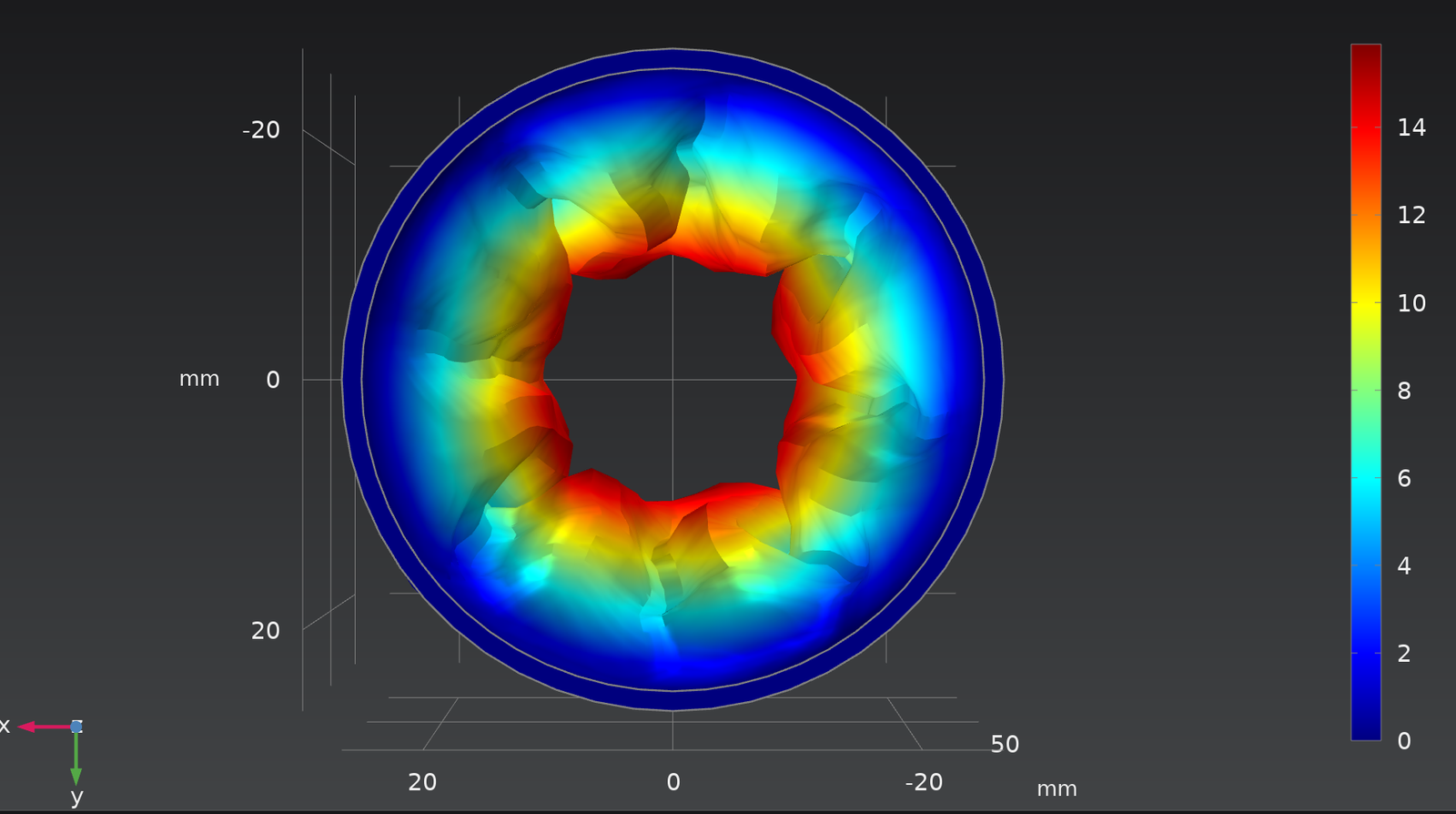
At AWJ Engineering, our team employed a segregated finite element method to analyze steady viscous fluid flow through a thin-walled elastic tube mounted between rigid sections. We coupled Navier-Stokes equations with solid mechanics equations of motion and a constitutive material model, incorporating a deforming domain (moving mesh) to capture the tube’s deformation effects on fluid dynamics.
This project highlights our expertise in multiphysics simulations for precise, real-world insights.
For more details on boundary conditions, solver settings, or similar analyses, contact us today.
Industry:
Client Type:
Research organization developing electrohydrodynamic propulsion technologies